Development
Jensen Huang’s Vision of AI: From Energy to Applications in a Five-Layer Stack
Jeremiah Tsung
Mar 20 2026 · 3 min read


(Image credit: NVIDIA)
Artificial intelligence is becoming a foundational technology for the modern world. As NVIDIA CEO Jensen Huang explains, AI is “not a clever app or a single model” but rather “essential infrastructure, like electricity and the internet.” Instead of being a single tool, AI is a large industrial system built on hardware, energy, and global investment. Because AI converts physical resources into computation, it operates on “real hardware, real energy and real economics.”
A major shift behind this transformation is how computers process information. Traditionally, software followed fixed instructions: “Humans described an algorithm. Computers executed it.” Data had to be carefully structured and retrieved through systems like SQL. AI changes this model completely. Modern systems can understand messy, unstructured information: images, text, sound, and context. Instead of retrieving prewritten instructions, AI “generates intelligence in real time,” meaning each response is newly created based on the user’s input.
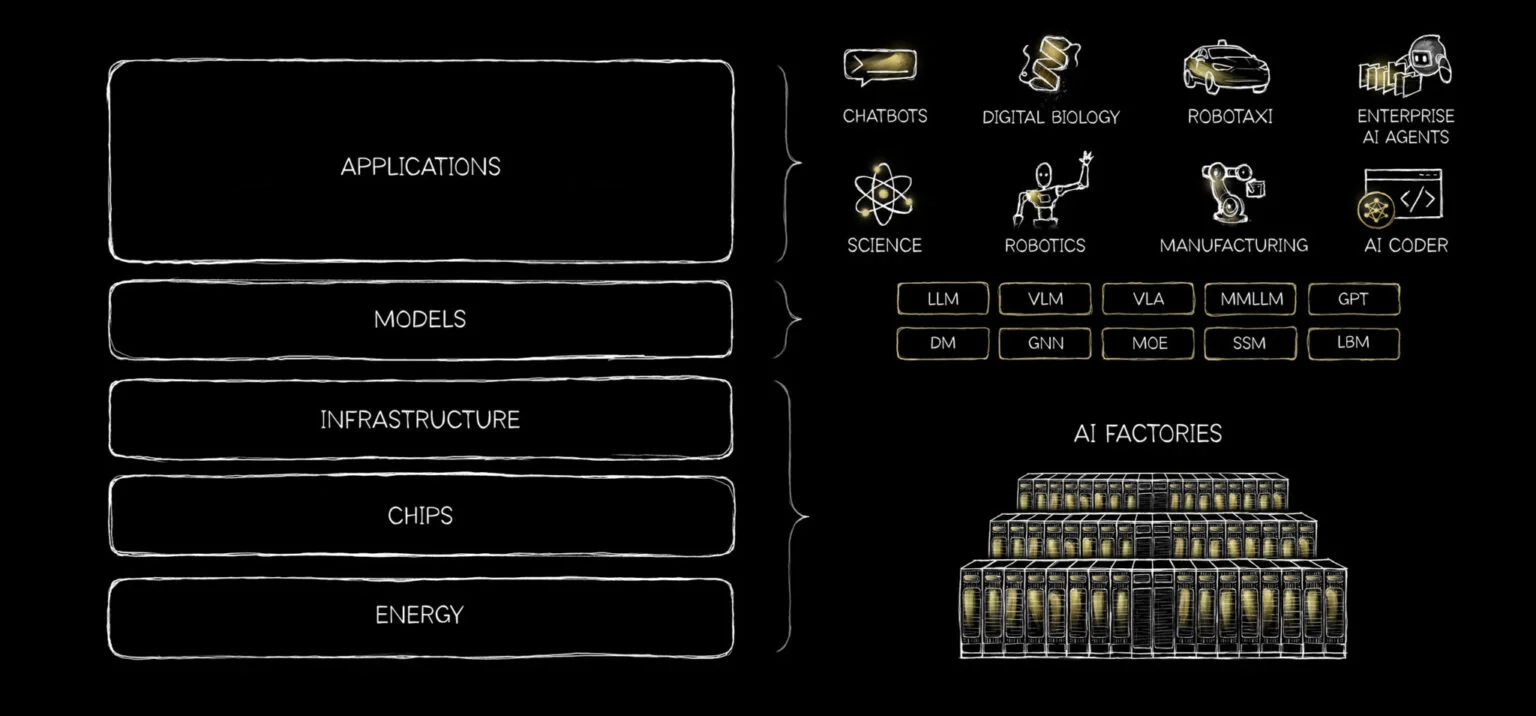
Because intelligence is now produced dynamically, the entire computing system underneath it has had to evolve. Huang describes AI as a five-layer infrastructure stack.
Energy
At the base is energy, the fundamental constraint of the system. Every AI output requires electricity because “every token produced is the result of electrons moving.” Without sufficient energy production, AI systems cannot scale.
Chips
Above energy are chips, specialized processors designed for massive parallel computation. These chips convert electricity into useful computation and determine how efficiently AI systems can operate.
Infrastructure
Next comes infrastructure, the physical systems that connect thousands of chips together. Data centers, cooling systems, networking, and construction all combine to form what Huang calls “AI factories.” Unlike traditional data centers built mainly to store information, these facilities are designed “to manufacture intelligence.”
Models
Above infrastructure are models, the algorithms that learn from data. While language models receive the most attention, Huang notes that AI models are expanding into many scientific fields, including biology, chemistry, physics, and robotics.
Applications
Finally, at the top of the stack are applications, where economic value appears. Examples include drug discovery platforms, legal assistants, robotics, and self-driving vehicles. As Huang notes, “Every successful application pulls on every layer beneath it,” from the model all the way down to the power plant supplying electricity.
The scale of this transformation is enormous. According to Huang, the world has already invested hundreds of billions of dollars into AI infrastructure, but “trillions of dollars of infrastructure still need to be built.” Around the world, new chip factories, computer assembly plants, and AI data centers are being constructed at historic speed.
This growth also creates large labor demand beyond the tech sector. Building and maintaining AI infrastructure requires electricians, pipefitters, steelworkers, network technicians, and other skilled workers. Huang emphasizes that “you do not need a PhD in computer science to participate in this transformation.”
At the same time, AI is increasing productivity in many professions rather than simply replacing them. In fields like medicine, AI can automate routine tasks while humans focus on judgment and care. For example, radiologists still play a crucial role because their job is not only reading scans but caring for patients. When AI handles repetitive work, professionals can spend more time on complex decisions and communication. In this way, “productivity creates capacity. Capacity creates growth.”
Recent improvements in AI models have accelerated this process. Over the past year, systems have improved their reasoning ability, reduced hallucinations, and become reliable enough for real-world use. Huang argues that “models became good enough to be useful at scale,” enabling practical applications in logistics, software development, manufacturing, and drug discovery.
Open-source models have also played an important role by spreading advanced capabilities widely. When powerful models become accessible, they increase demand for computing power, chips, and infrastructure across the entire system.
Ultimately, Huang frames AI not just as a technological change but as an industrial transformation. It affects energy systems, global manufacturing, labor markets, and economic growth. Because intelligence can now be produced on demand, societies are building new infrastructure to support it.
For Huang, the conclusion is clear: “AI is becoming the foundational infrastructure of the modern world.” The pace of development and the decisions made today—about investment, participation, and responsible deployment—will shape how this new technological era unfolds.